
Today even those who support Prime Minister Modi feel there is a certain sense of listlessness in this government. What is it intending to achieve? This is not easy to say, notes Aakar Patel.

'It was India's good fortune to have a Vajpayee lead the government at this crucial moment in history.' 'By taking the N-decision he saved future generations of Indians from being 'Kosovoed' or 'Iraqed',' says Colonel Anil A Athale (retd).

We have the workforce, now we need to ensure that we take full advantage of game-changing technologies and geopolitical openings, suggests Jayant Sinha, chairman, Parliament's Standing Committee on Finance.

The N-treaty volte face is a big loss of face for our country. I wonder who will take a frivolous India seriously now. Given the resounding triumph of Leftist blackmailers, wannabe blackmailers can roll their sleeves up and expect a field day hereafter.
India on Wednesday said Iran should fully cooperate with the International Atomic Energy Agency with a view to restoring confidence of the international community that its nuclear programme is peaceful in nature.

Ahead of his much-anticipated visit to conflict-torn Ukraine, Prime Minister Narendra Modi on Thursday said India firmly believes that no problem can be solved on the battlefield and it is ready to extend all possible cooperation for the restoration of peace and stability in the region.

To avoid the kind of nuclear disaster that has happened in Japan, Professor Dirk Matten of the Schulich School of Business, York University, suggests that India should rely more on coal-fired energy generating plants and energy efficiency, instead of going for nuclear reactors in a big way.
Srinivasan said instead of relying on nuclear energy, the country should look at available renewable sources of energy to meet the energy requirement.
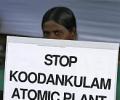
Expressing unhappiness over the Supreme Court order which gave the green signal for commissioning of the Kudankulam Nuclear Power Plant, anti-nuclear activists on Monday termed the decision as "unjust" and said protests will continue.

John Kerry, US Secretary of State, who is here for the 2nd Indo-US Strategic and Commercial Dialogue, said his country would want its civil nuclear cooperation with India to take shape in setting up of reactors.
India's civil nuclear liability regime has raised serious questions about the country's capacity addition programme. In an interview with Sanjay Jog, G R Srinivasan, former vice-chairman of the Atomic Energy Regulatory Board and currently principal associate-nuclear power business in GMR Energy Ltd, says the regime is tremendously unbalanced and may adversely affect the nuclear capacity addition programme.
As soon as the amended Atomic Energy Act is cleared, Reliance Energy would be the first company to come forward to set up nuclear power plants
The Department of Atomic Energy's Board for Research in Nuclear Sciences invites applications for its prestigious scheme.

'This was undoubtedly a premeditated strategy to thwart India's entry into the NSG.' 'If India hopes to be a major player, it must use its rising clout on the world stage to influence amenable members of the group to alter such discriminatory practices and ensure fair rules of engagement,' says Vivek Gumaste.
"The Department of Atomic Energy and its agencies, including the Nuclear Power Corporation of India, have been instructed to undertake an immediate technical review of all safety systems of our nuclear power plants, particularly with a view to ensuring that they would be able to withstand the impact of large natural disasters such as tsunamis and earthquakes," he had said.
Cautioning about the growing risk of nuclear weapons falling into the hands of terrorists or extremists, Prime Minister Manmohan Singh on Monday said that all countries must ensure that dangerous hands are denied atomic material and technology.Underlining that India has no intention to engage in an arms race with anyone, Singh said New Delhi is "fully committed to nuclear disarmament that is global, universal and non-discriminatory in nature."
Noting that the 123 Agreement between India and the US reflected deepening relationship between the two countries, top Obama Administration officials have said that it would have broader impact in the Indo-US ties.
S P Udayakumar, who is fasting along with his associate M Pushparaya, gives us a first-person account from Idinthakarai, Ground Zero of the protests against the nuclear power plant in Tamil Nadu.
Stepping up their protest against the Kudankulam Nuclear Power Plant, anti-nuclear activists have now decided to go in for 'jal satyagraha' throughout the Tamil Nadu coast on September 22.
An uneasy calm prevailed in Kudankulam on Tuesday with police tightening vigil as anti-nuclear protesters continued with their relay fast at Idinthakari, epicentre of protests against the Kudankulam Nuclear plant, condemning the action against anti-KNPP activists.

Notwithstanding the NSG waiver for New Delhi, Japan on Wednesday appeared non-committal on civil nuclear cooperation with India even as the two countries agreed that atomic power could play an important role as a sustainable and non-polluting source of energy in meeting the growing global demands.

Major General S C N Jatar, who passed into the ages on Monday night, thwarted anti-national forces at the peak of the Assam agitation. Colonel Anil A Athale (retd) salutes this officer and gentleman.
Pitching for enactment of a law to fix civil damages caused by nuclear accidents, Atomic Energy Commission Chairman Srikumar Banerjee said neither the Indian Environmental Protection Public Liability Insurance Act, 1991, nor the Indian Atomic Energy Act had provisions for damages caused due to war or radioactivity.
Amid public resistance to nuclear power projects at Jaitapur and Koodankulam, the Department of Atomic Energy has said the work on both plants will be completed but their could be delay.
The Indo-US civilian nuclear deal and the go-ahead for atomic commerce obtained by India from the NSG will help address world's shared interests in energy security and climate change, Minister for External Affairs Pranab Mukherjee said on Tuesday.
Hundreds of anti-nuclear activists and leaders of different political outfits were detained in Chennai on Monday when they attempted to lay siege to the Tamil Nadu assembly demanding scrapping of the Kudankulam Nuclear Power Plant. S Saraswathi reports.

The two PMs may also explore ways to further deepen ties between the navies of the two countries to check China's heightened activities in the Indian Ocean.
India signed a civil nuclear cooperation agreement with the UK,on Thursday, making it the eighth country to enter into such pact with New Delhi since the lifting of atomic trade embargo in 2008.
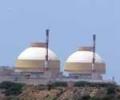
Prohibitory orders have been clamped in a seven-km radius around the controversial Kundankulam Nuclear Power Plant as anti-nuclear activists have threatened to picket it on Monday.
A tense situation prevailed as over 1,000 anti nuclear protesters made a vain bid to lay a siege to the controversial Kudankulam Nuclear Power Plant, protesting against the proposed loading of fuel.
South Korean President Lee Myung-bak, during a bilateral meeting with Singh on Sunday, had requested that his country be allocated a site in India to build nuclear reactors.
Parliament must insist that the government should direct its Department of Atomic Energy to immediately examine and make recommendations to the government on the structure of an independent surveillance and regulatory authority for the defence nuclear facilities, says Dr A Gopalakrishnan.

The partial withdrawal would mean that Iran would stop exporting enriched uranium stocks as stipulated by the 2015 agreement.

The Indian position on the Russia-Ukraine war and the unconditional treaty between China and Russia appear to have caused some ripples in India-US relations and led to a reappraisal of India's usefulness to the US in the eventuality of a conflict with China, notes Ambassador T P Sreenivasan.
Acting tough against anti-nuclear activists demanding closure of Kudankulam nuclear power plant, five key functionaries of a body spearheading the movement against KNPP were arrested at the plant site on Monday.
Women and men would stand in the sea waters for two hours in turns, Pushparayan, leader of the Peoples Movement Against Nuclear Energy, spearheading the year-long agitation, told media persons in Kudankulam.
Taking a cue from 'Jal Satyagraha' activists in Madhya Pradesh, opponents of the Kudankulam Nuclear Power Plant today threatened to stand in the sea off Idianthakarai coast from Thursday as a stepped-up form of agitation.
In a volte-face, Peoples Movement Against Nuclear Energy leader S P Udayakumar on Wednesday decided not to surrender, a day after he made a dramatic appearance and announced he would turn up before the police. Amid continuing protests against the Kudankulam Nuclear Power Project, Udayakumar's change of plans was announced by anti-corruption activist Arvind Kejriwal, who has extended his support for the anti-nuclear stir.
Anti-nuclear movement leader S P Udayakumar on Tuesday gave up his plan to surrender to the police after making a dramatic appearance to do so and was whisked away by his supporters.
 © 2026 Rediff.com - Advertise with us - Disclaimer - Privacy Policy - Sitemap - Feedback - About us - Terms of use - Grievances